
Testicular torsion care for babies and children by CocoonKids paediatric surgeons at Manipal Hospitals units in Bengaluru.
Secure your child’s appointment with our experienced pediatric doctors and ensure healthy growth and happy milestones.
Written by the CocoonKids paediatric surgery team · Last updated 24 November 2026
Testicular torsion is when a testis twists on its cord and loses its blood supply. It is most common around puberty and in newborns. The main sign is sudden, severe pain in the testis or scrotum, often with vomiting. It needs emergency surgery to untwist and fix the testis, ideally within about 4 to 6 hours of the pain starting, so go to an emergency department straight away.
When to go to the emergency department
Sudden testicle pain is an emergency. Go to the nearest emergency department now, and do not wait for an OPD appointment, if your son has: sudden, severe pain in a testis or the scrotum; testicle pain with nausea, vomiting or tummy pain; testicle pain that has lasted more than an hour or continues when he is resting; a swollen, red or dark scrotum; or (in a newborn) a scrotum that is swollen, hard or discoloured, even if he does not seem to be in pain. Do not give him anything to eat or drink on the way, in case he needs an operation.
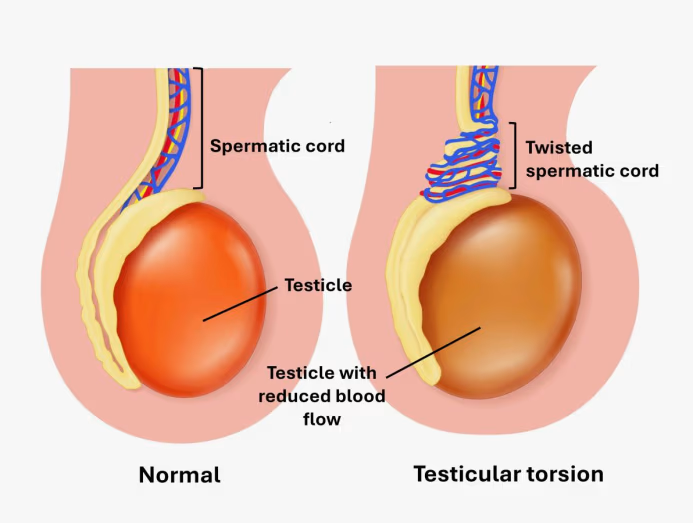
Testicular torsion is a twist of the spermatic cord, the cord that carries blood vessels to the testis. When the cord twists, blood flow stops and the testis begins to die within hours.
It is the most important cause of sudden scrotal pain in boys, because it is the one that cannot wait. Many boys who get torsion are born with a testis that is attached loosely inside the scrotum, so it can swing and twist more easily. This usually affects both sides, which is why the surgeon fixes the other testis as well during the operation.
Torsion can happen at any age, but there are two peaks: around puberty and in newborn babies.
The typical sign is sudden, severe pain in one testis. Other signs include:
Boys, especially teenagers, are often embarrassed and may say only that they have tummy pain. If your son has sudden tummy pain, gently ask about pain in his testicles. Doctors are taught to examine the testes in any boy with sudden lower tummy pain for this reason.
The time from the start of pain to surgery is the main factor in whether the testis can be saved. Guidelines describe a critical window of about 4 to 6 hours.
The American Academy of Pediatrics notes that when torsion is treated within 6 hours of the pain starting, more than 9 in 10 testes can be saved, but after 24 hours fewer than 1 in 10 can. How tightly the cord is twisted also matters: a tight twist can damage the testis within a few hours.
So do not wait to see whether the pain settles, do not give pain relief and wait until morning, and do not wait for a clinic appointment. Go straight to an emergency department. Our article on why sudden testicle pain is an emergency explains this in more detail.
Several conditions cause scrotal pain in children, and some are less urgent, but only a doctor examining your child can tell them apart, so every case of sudden pain needs to be seen urgently.
If torsion is suspected, the team moves quickly towards surgery. Diagnosis is based mainly on the history and examination.
Your child should not eat or drink anything from the time you suspect torsion, in case he needs an anaesthetic.
Surgical exploration is the treatment: the surgeon untwists the testis and stitches it in place so it cannot twist again. The operation is done under general anaesthesia through a small cut in the scrotum.
In newborns with torsion, the other testis is fixed as well; how quickly surgery is done depends on the baby’s findings, and your surgeon will explain the plan.
Most boys go home the same day or the next day and recover over the following weeks. Your team will give you written instructions.
Call your surgical team if: the wound becomes red, hot or leaks pus, there is a fever, or swelling or pain is getting worse instead of better.
When torsion is treated quickly, the testis usually survives. Even so, a testis that has twisted may later become smaller (atrophy), so it is checked at follow-up.
Teach your son, as he grows, that sudden pain in a testis is an emergency, and that he should tell an adult straight away even if he feels embarrassed.
Testicular torsion is treated as an emergency by CocoonKids paediatric urology surgeons at Manipal Hospitals units. Families can see Dr Koushik Herle, Consultant Paediatric Surgeon & Paediatric Urologist.
Boys with scrotal pain are also treated by Dr Dhiraj K Balaji and Dr Rashmi D.
For sudden pain, go to the nearest emergency department; do not book a clinic visit. For follow-up after treatment, or for non-urgent worries such as a testis that is sometimes hard to find, use find a paediatric surgeon near you or contact CocoonKids on +91 63669 67044.
This page is general information for parents and does not replace an examination and advice from your child’s own doctor.
Our paediatric surgeons see children at these Manipal Hospitals units in Bengaluru:
Pediatric FAQs provide quick, clear answers about children’s health, treatments, and care to help parents know what to expect.
Sometimes the testis twists and then untwists by itself, so the pain eases. This is called intermittent torsion. It still needs urgent review, because the testis can twist again at any time and the surgeon may advise fixing both testes to prevent it. Never assume eased pain means the danger has passed.
No. Do not delay. Pain relief may hide how severe the problem is, and every hour without blood flow matters. Take your son straight to an emergency department, and do not give him food or drink on the way because he may need an anaesthetic.
No. A Doppler scan is useful, but blood flow can appear normal early in torsion or when the twist is partial. Guidelines say a scan should never delay surgery when torsion is suspected. If the doctor is concerned after examining your son, the safer course is to operate.
Boys who get torsion often have a loose attachment of both testes inside the scrotum. Fixing the other testis with a few stitches during the same operation lowers the risk of it twisting later. It is done through a small cut on that side of the scrotum.
Usually, yes. One healthy testis normally makes enough hormones for normal puberty and enough sperm for fertility. Some studies show lower sperm quality after torsion, so your surgeon will discuss follow-up. If he wishes, an artificial testis can be considered when he is older.
Yes, but it can also happen during sleep or at rest with no trigger. Pain after an injury that is severe, lasts more than an hour or comes with swelling or vomiting should be checked in an emergency department, because injury can cause torsion as well as bruising or damage to the testis.